
Dismantling bias and shaping the digital frontier: The role of civil society across Africa

ADDIS ABABA, Ethiopia - For generations across Africa, the custom of favouring boys over girls has dictated who attends school, who inherits land and whose voice carries authority.
In Cairo, however, Dr. Hala Nasr grew up in a home that deliberately challenged this entrenched bias.
"My father and mother treated us completely equally. In fact, they placed my sister and me before my brother in many aspects," recalls Dr. Nasr, now an assistant professor of accounting and a leader within Egypt's National Council for Women.
Over more than a decade of field missions across Egypt, Dr. Nasr saw that her upbringing remained the exception; patriarchal norms continued to limit women’s autonomy and fuel discrimination. This reality cemented her pragmatic approach to leadership. "I believe in never presenting a problem without a solution," she explains.
A solutions-based strategy
Today, Dr. Nasr is part of the Spotlight Initiative Africa Regional Programme Civil Society Regional Reference Group (CSRRG). Composed of 15 grassroots leaders, feminist organizers and advocates from across the continent, the CSRRG ensures the principle of "leaving no one behind" is an operational mandate.
The group holds three main responsibilities: advise on programme design, lead public advocacy and provide oversight. As voting members of the Regional Steering Committee alongside the African Union Commission, the European Union and UN agencies (UNDP, UNFPA, UNICEF, UN Women), CSRRG members directly influence priorities and ensure funding reaches autonomous grassroots movements.
"My background with women in Egypt drove me to join this larger, continental African community," Dr. Nasr explains. "Here, we don't just speak about challenges, we co-create solutions."
Confronting digital violence
At the African Union Headquarters in Addis Ababa during AU InnoFest ’26, Dr. Nasr brought this mandate to the launch of the African Community of Practice on Technology-Facilitated Violence Against Women and Girls (TF-VAWG), under the banner #FORALLWOMENANDGIRLS.
"Technology is now controlling the world: it controls youth, women and the economy," Dr. Nasr observed. "Today, we confront the violence against women that stems from or is reflected through technology. We sat at the policymaking table to be part of crafting the policies for this major platform, uniting international bodies to combat violence against women in Africa."
Championing data-driven accountability
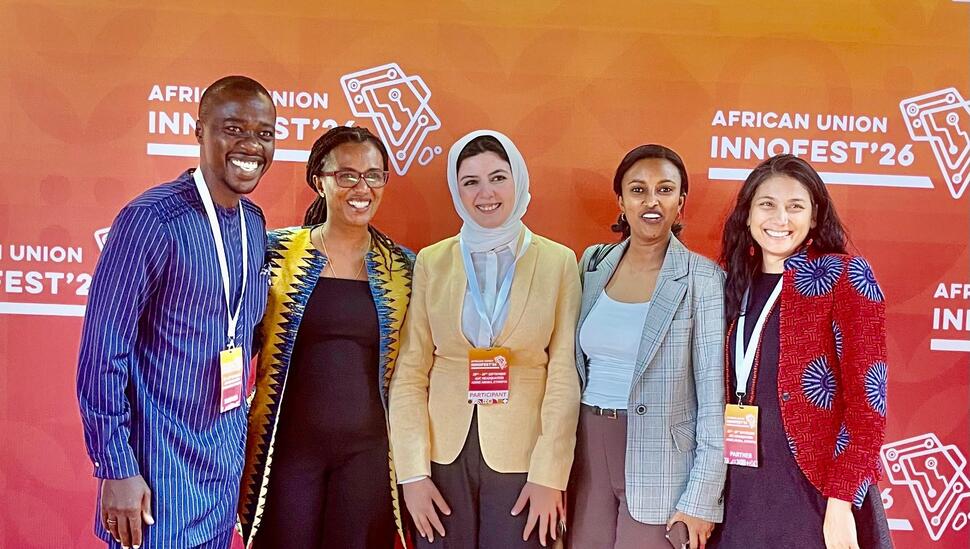
Representing the CSRRG, Dr. Nasr championed the creation of a standardized African Index on tech-facilitated violence against women and girls.
"It is essential that we have credible rights-based data," she stressed. "This data directs us toward supporting countries that need assistance the most, while allowing us to cross-pollinate solutions across nations. In this platform, civil society's indicators and voices are shaping the regional agenda."
By bridging grassroots realities with continental policymaking, leaders like Dr. Nasr prove the essential power of the CSRRG: ensuring Spotlight Initiative remains accountable, transformative and advances progress towards an Africa where every girl is safe, valued and free to lead.
By Serawit Atnafu

