
A bold push for safe women’s leadership through Spotlight Initiative in Zambia

LUSAKA, Zambia - With Zambia’s 2026 general elections approaching, Spotlight Initiative is working to ensure that every woman can participate safely and confidently in civic and political life. The effort directly reflects the spirit of the 2026 International Women’s Day theme: Rights, justice and action for all women and girls.
Supported by the Embassy of Ireland, the Initiative brings together several United Nations agencies, including the International Organization for Migration (IOM), United Nations Development Programme (UNDP), United Nations Educational, Scientific and Cultural Organization (UNESCO) and United Nations Population Fund (UNFPA) to move beyond advocacy and deliver practical solutions that strengthen women’s participation in public life.
At its core, the initiative addresses the structural barriers that discourage women from leadership. By challenging the root causes of exclusion and promoting a culture of safety, the programme reinforces a simple but powerful principle: the right to lead belongs to everyone. The goal is to ensure that women’s participation in public life is determined by their abilities, not by systemic barriers or fear.
The need for such action is clear. A joint report by the Inter-Parliamentary Union (IPU) and the African Parliamentary Union (APU) found that 42 per cent of women parliamentarians in Africa have experienced threats of death, rape, beating or abduction, often through social media. These threats are frequently intended to push women out of political spaces and silence their voices.
To confront this challenge, Spotlight Initiative has convened a series of high-level engagements with key stakeholders, including the National Prosecution Authority (NPA), the Zambia Police Service and civil society organizations such as the Non-Governmental Organizations Coordinating Council (NGOCC), Lifeline Childline Zambia, the National Democratic Institute (NDI), The Carter Center and Caritas Zambia.
These discussions have brought attention to what some participants describe as the “hidden tax” women pay to run for public office. One issue highlighted during the dialogue is a gap in the legal framework: Zambian law does not yet explicitly recognize violence against Women in elections as a distinct offence. Without clear legal provisions, accountability becomes difficult and protection mechanisms remain limited, leaving female candidates vulnerable to intimidation, harassment and reputational attacks.
By identifying these gaps, the Initiative aims to strengthen protections through the development of referral pathways, reporting systems and grievance mechanisms specifically designed to address violence against women in elections. The objective is to ensure that the promise of “Justice for All” includes concrete safeguards for women navigating political life.
The broader Spotlight Initiative framework transforms the theme’s call for action into coordinated, multi-agency results. UNFPA leads efforts on gender-based violence response, coordination and support to women’s movements and civil society organizations working on gender equality.
At the same time, other participating agencies contribute their expertise. UNDP supports reforms in laws and policies while advancing women’s political participation. UNESCO focuses on prevention through education, including integrating life skills and health education into curricula to address school-related gender-based violence. Meanwhile, IOM works to ensure that migrant and cross-border women, including sex workers, are included in protection mechanisms so that no woman is left behind, regardless of her legal status or location.
Momentum is now shifting from dialogue to implementation. During a February meeting at Elections House, the Electoral Commission of Zambia (ECZ) signalled a decisive step forward by committing to formalize collaboration with stakeholders through its Legal Department. This includes integrating Conflict Management Committees into broader initiatives aimed at preventing electoral violence.
Operational measures are also being put in place. Lifeline Childline Zambia confirmed that its toll-free helplines 933 and 116 will remain active throughout the election cycle to receive and respond to reports of violence against women in elections and other protection concerns. These lines now operate with specialized procedures and reporting tools designed to document and classify incidents of electoral violence targeting women.
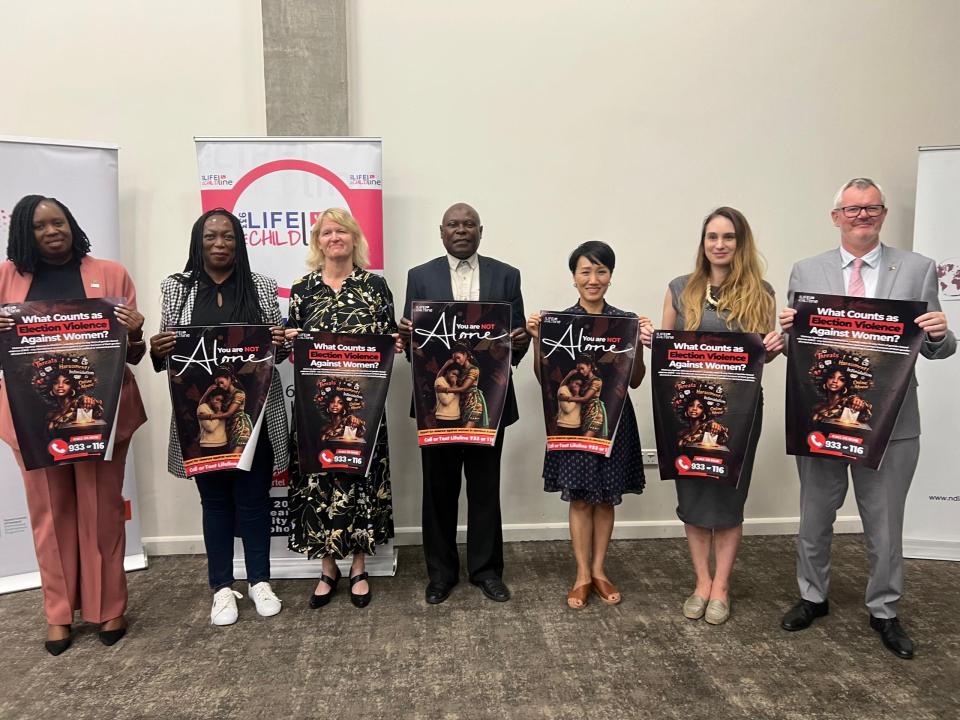
Efforts to address emerging digital threats are also underway. PANOS Institute Southern Africa is establishing an information desk to counter gendered disinformation and the growing use of “deepfakes” intended to discredit female candidates. At the same time, The Carter Center has launched training initiatives to strengthen election monitoring and prevention efforts, while the National Democratic Institute is promoting women’s political participation across 32 districts and supporting reporting mechanisms in partnership with Lifeline Childline Zambia.
Through these coordinated actions, the United Nations in Zambia and its partners aim to create a future in which leadership is defined by merit and not by the ability to withstand harassment or intimidation.
By strengthening collaboration across institutions from grassroots organizations such as Young Women in Action (YWA) to national decision-makers at the Electoral Commission, Spotlight Initiative is helping to reshape the conditions for women’s leadership in Zambia.
Ultimately, the initiative is not only preparing women for the 2026 elections. It is contributing to a broader transformation of Zambia’s democratic landscape, one that reflects the principles of rights, justice and meaningful action for all women and girls, and strengthens women’s representation in governance for years to come.
Story by Christabel Chengo Chabwela, Communications Analyst, UNFPA Zambia